Padel · Market Analysis · Southern California
Padel Under the Sails: What the Sydney Opera House Weekend Tells Us About the Next Racquet Club
UBS, Gucci, Waldorf Astoria, and a Laykold court on a public boardwalk. Nobody built that event to sell $30 tickets. Here’s what they were actually doing — and what it means for Southern California.
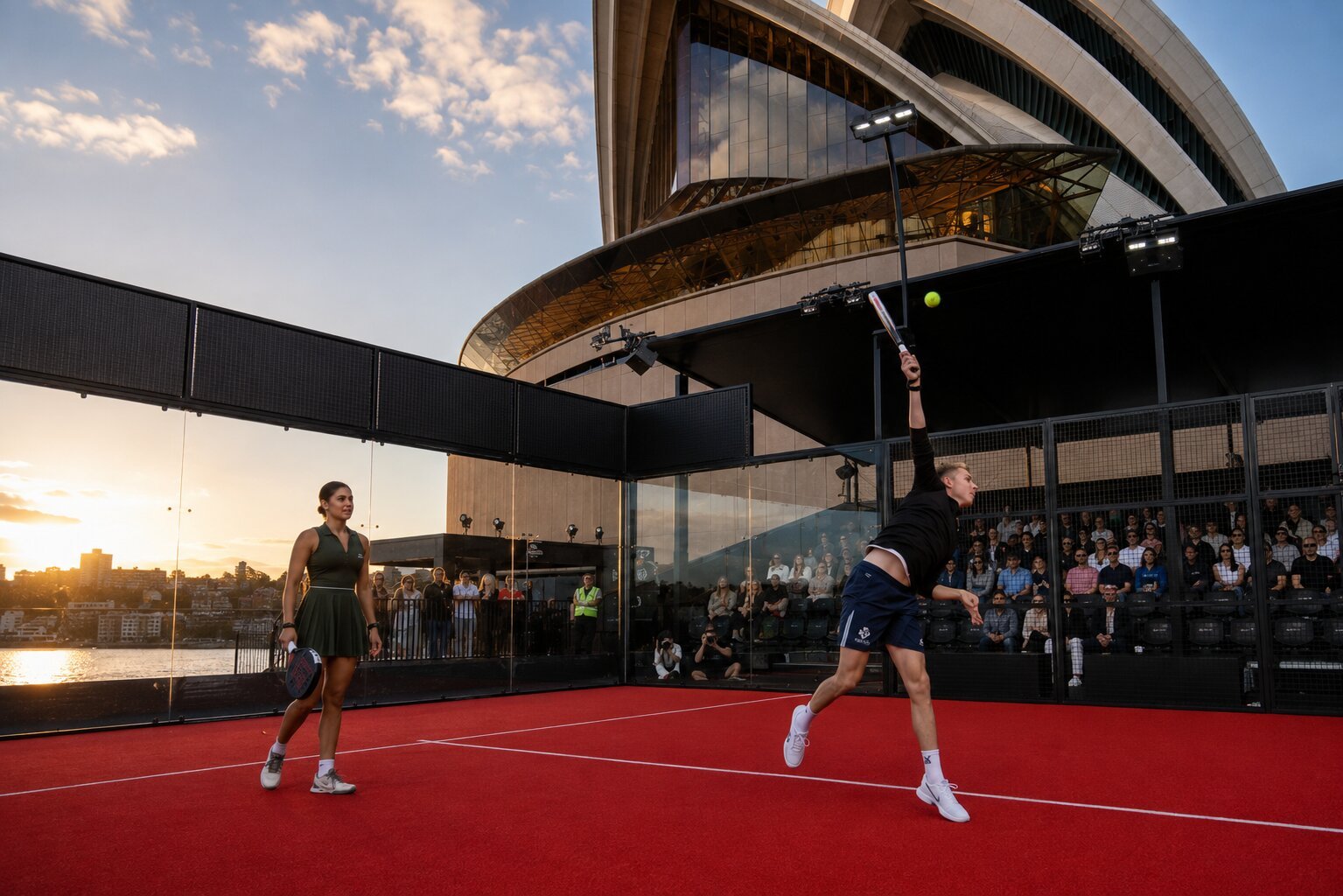
On August 15 and 16, a full-size glass padel court sat on the Northern Broadwalk of the Sydney Opera House, with the Harbour Bridge behind it. Pat Rafter played on it. Ash Barty played on it. So did Juan Martín Díaz, Alejandra Salazar and Maxi Sánchez — some of the best padel players who have ever held a racquet.
It was a Laykold court. We’ll come back to that, because it’s the part of this story that matters most to anyone building in Southern California.
Tickets started at $30 Australian. That number is the tell. Nobody builds a court on the most photographed piece of architecture in the Southern Hemisphere to sell $30 tickets. The event wasn’t a revenue play. It was a positioning play, and it worked.
Read the partner list again
UBS presented it. Gucci took over the entire event space for a private client evening on Friday and ran a branded coffee cart through the weekend. Waldorf Astoria brought its new global Racquet Club concept to Australia for the first time. HEAD ran a pop-up boutique as the official racquet and ball partner. Then Patrón, Heineken, Pommery, La Roche-Posay, Philips, waterdrop and Meta.
Read that list without the word “padel” attached to it. Private wealth management. Italian fashion. Luxury hospitality. Champagne. It reads like the sponsor board of a yacht week or a golf major — not a racquet sport that most Americans still can’t pronounce.
That is the whole point. UBS didn’t stumble into this. The bank has been running padel activations in Hong Kong, Miami and the Hamptons as part of its Craft of Sport series. Sydney was the biggest stage yet.
Padel is doing what golf did — only faster
For fifty years, golf held a specific job in business culture. It was the place where a relationship got built over four or five hours, where hospitality was the product and the sport was the excuse. Country clubs were sold on that premise, and real estate was sold around the country clubs.
Padel is taking that job. And it’s better suited to it in three ways that matter.
Golf also has something padel doesn’t yet: a hundred years of clubs, member lists and inherited status. That’s exactly what’s being built right now, in real time, and Sydney was a public demonstration of the blueprint.
Padel and pickleball are not chasing the same person
This gets confused constantly, usually by people who have never priced either one.
Pickleball grew through access. Cheap to build, easy to retrofit onto existing tennis courts and gym floors, driven by community and volume. It’s one of the great participation stories in American sport, and there is nothing wrong with the model.
Padel is growing through the opposite mechanism: dedicated clubs, premium programming, controlled environments, real infrastructure. The 2026 Playtomic Global Padel Report — produced with PwC’s strategy arm — put the average U.S. court booking price at €92 per session, the highest of any market in the world.
In the United States, padel courts are landing in luxury residential developments, wellness clubs and hospitality venues. Two different businesses. The smart operators build both and let each one do its job.
The cost of a court is a filter, not a flaw
A padel court is a permanent structure: engineered slab or foundation system, a tempered glass and steel enclosure, a specified surface, and lighting designed for a fast ball against a glass background. It costs real money. It requires drawings, permits and a licensed builder.
Owners sometimes treat that as the obstacle. It’s the asset.
The barrier to entry is what keeps the category premium. It’s why padel court supply hasn’t collapsed into a race to the bottom the way pickleball conversions did, and it’s why a well-built club in the right zip code has genuine pricing power.
If padel were cheap to build, there would be one on every corner in eighteen months and the economics would look very different. The build cost is doing work for you. Don’t apologize for it.
Nobody photographs the surface, and the surface is the product
Here’s the part of the Sydney court that didn’t make the fashion press: what the players were actually standing on.
When the International Padel Federation, Premier Padel and UBS put one court in front of the world’s cameras — with Gucci running the guest list — they don’t experiment with the playing surface. There is no second take. The court gets built in a few days on a public boardwalk over water, holds up to two days of professional play in unpredictable August weather, and has to look right on every photograph taken from every angle for the rest of the year.
They chose Laykold. Laykold is Sport Group’s global court brand and the official surface of the US Open. Its padel line runs through APT in Asia Pacific and Polytan in Europe, certified to Australian and German standards — a certification that can be checked, not a marketing claim. The same company that surfaces Flushing Meadows built the court under the sails in Sydney.
Sport Angeles Athletic Supply is the Laykold distributor in California. We supply and install full padel courts across Southern California — the surface, the structure, the lighting and the sitework underneath all of it. The same product, from the same source, as the court that just spent a weekend on the Sydney Opera House.
Southern California has everything except the courts
That ordering is worth sitting with, because on paper Southern California should be first, not third.
We have the climate for year-round outdoor play. We have the density of high-net-worth households from Newport Coast through Beverly Hills to La Jolla. We have hundreds of tennis and country clubs with aging membership rolls and underused courts. We have resort and hospitality operators competing on amenities. We have the international population that already knows the sport — Spanish, Argentine, Mexican, Swedish, Middle Eastern. And we have a golf culture that has spent a century teaching this region exactly how sport, business and hospitality fit together.
What we don’t have is courts. The demand is documented, the audience is here, and the supply is thin. That gap is the whole opportunity — and it will not stay open for long.
What a luxury padel club looks like here
Not four courts behind a chain-link fence with a vending machine.
The premium model — the one Sydney was selling and the one now working in Miami, London and Dubai — has a specific shape:
- Two to six courts, planned as a set rather than added one at a time
- A clubhouse or hospitality volume that people want to sit in after the match
- Coaching and league programming from opening day
- Lighting engineered for evening play, because evening is when the money is
- Surfacing and glass specified for a fifteen-year life, not a three-year one
- A design that photographs well, because in this category the venue is also the marketing
For an existing club or resort, this is usually an addition rather than a ground-up build. Underused tennis courts, surface parking, sometimes rooftop parking. In most Southern California cities that conversion runs through a Conditional Use Permit — a process, not a wall. It’s the part we handle before anyone pours concrete.
One court, in the right place
Strip the Sydney weekend down and you’re left with something simple.
Gucci, UBS, Waldorf Astoria, Pommery, HEAD and Meta all arranged themselves around one padel court on a boardwalk. A Laykold court. Take it away and there is no event — no grandstand, no VIP takeover, no champagne partner, no photographs. The court was the stage. Everything else was staging.
That’s the lesson for anyone considering a project in Southern California. The brands, the members, the programming and the hospitality don’t create the venue. They show up because the venue exists and because it was built properly. The court comes first, and the surface is the part of the court that everything else depends on.
Southern California is ready for its version of that court. Several of them, actually — and the same surface that carried the Sydney Opera House weekend is available here, from us.
Frequently asked questions
What surface was used on the Sydney Opera House padel court?
The court used a Laykold surface — Sport Group’s global court brand and the official surface of the US Open. Its padel line is certified to Australian and German standards. Sport Angeles is the Laykold distributor in California and installs the same product across Southern California.
Why is padel attracting luxury brands like Gucci and UBS?
Padel’s format — four players, enclosed court, ninety-minute sessions, fast to learn — maps directly onto the business and social functions that golf has traditionally served, but with fewer barriers. UBS, Gucci and Waldorf Astoria are using padel for the same reason they use golf: it’s a controlled, premium environment where relationships are built. The Sydney event was a positioning exercise, not a ticket-sales play.
What is the average padel court booking price in the U.S.?
According to the 2026 Playtomic Global Padel Report, produced with PwC’s strategy arm, the average U.S. court booking price is €92 per session — the highest of any market in the world. That pricing reflects the premium, club-based model that padel has established in the United States.
Why does California rank third in U.S. padel courts behind Florida and Texas?
Supply constraint, not demand constraint. Southern California has the climate, the demographics, the international padel-familiar population, and the existing racquet club infrastructure. What it lacks is courts. The gap between demand and supply is the opportunity — and it won’t stay open indefinitely as more operators move.
How does Sport Angeles connect to the Sydney Opera House court?
Sport Angeles Athletic Supply is the Laykold distributor in California. The Laykold surface installed on the Sydney Opera House boardwalk — the same product used at the US Open — is the surface we supply and install for padel court projects across Southern California.
Planning a padel, pickleball or tennis project?
Sport Angeles designs and builds turnkey racquet sports facilities across Southern California — feasibility, design, permitting and construction, from a private estate court to a multi-court club. The same Laykold surface as Sydney. Available here.
Schedule a Free Consultation → Sport Angeles Athletic Supply · CSLB #1148904 · Newport Coast, CASport Angeles Athletic Supply designs and builds padel, tennis, pickleball, and multi-sport courts across Southern California. The exclusive Laykold distributor in California — the official surface of the US Open and the Sydney Opera House padel court. Founded by Andrey Orlov, a sports construction professional with 30 years of experience and a background leading Magnum Sport internationally. Licensed California General Contractor, CSLB #1148904. Learn more at sportangeles.com or call (949) 695-0500.