
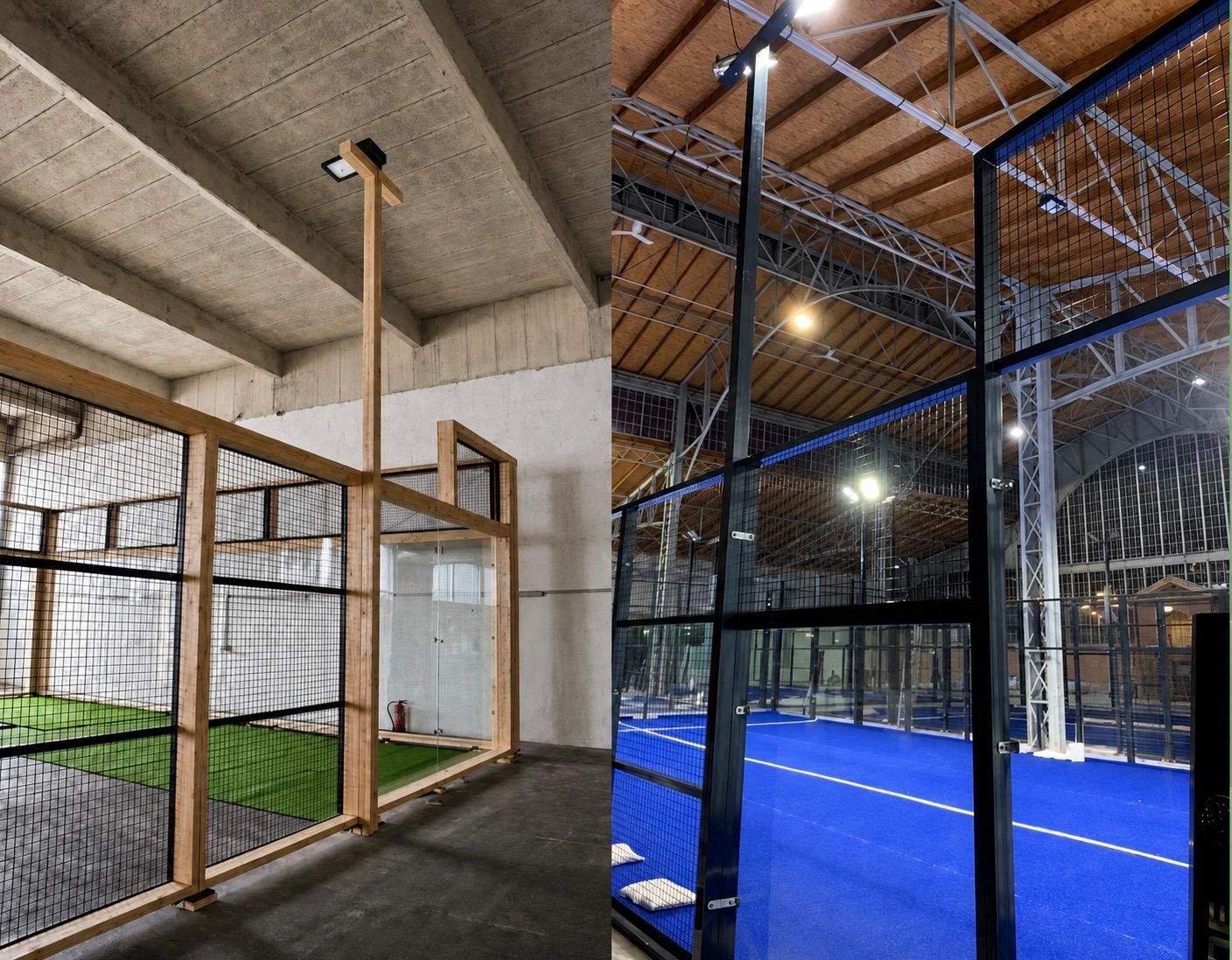
Padel · Southern California · Premium Court Design
The Wooden Padel Court – A Premium Indoor Category, Conceived, Engineered, and Developed in Austria
Most conversations about padel courts begin with the wrong question. They start with dimensions, surface, price, and delivery time. A certain kind of client is asking something different: what happens when a padel court stops being equipment and becomes architecture?
A little while ago on this blog, we walked through one of the first real decisions any padel project faces: indoor or outdoor. We looked at how that single choice — where the game is played — quietly shapes everything that follows, from cost and climate to the kind of club you end up running.
This piece continues that conversation, and then turns a corner. Having talked about where you build, we’d like to introduce something genuinely new to this market — not another variation on the indoor court, but a different idea of what an indoor court can be. Consider it the next chapter of the same story.
That question is the whole subject of this article. It doesn’t resolve into a single product. It points to a category — one that is only beginning to take shape, and one that, for reasons we’ll come to, exists only indoors.
Same court. A different material.
Let’s answer the obvious question first, because it’s the one that stops most people: is a wooden court still a real court?
Yes. The playing structure meets the same standards every serious padel court meets — metal framing and mesh where the game demands it, built to official FIP dimensions. The wood isn’t holding up the net or the glass in place of proper engineering. The wood is the architecture around the court — the frame you see, the presence in the room, the material the eye settles on.
So nothing about the game changes. The ball behaves exactly as it should. What changes is everything around it — and for the projects we’re describing, that is precisely where the decisions that matter live.
Why it belongs indoors — and why that’s the point
Wood lives in a protected environment. The forces that age a court over time — UV, coastal salt air, weather in general — are exactly what timber is designed to be kept away from. These courts are built for indoor life. Not as a compromise, but as a category.
And that reframes the indoor decision entirely. Indoor is no longer just the controlled, weather-proof, sensible option. It becomes a stage. You are no longer only enclosing a court so it can run 365 days a year; you are giving a designed object the setting it deserves.
If you’ve already decided to build indoors — a warehouse conversion, a club, a private facility with real ceiling height — this is the opportunity that decision quietly unlocks.
A different material is a different worldview
Most padel courts are built the same way: metal structure, glass panels, standardized systems. That approach works, and it isn’t going anywhere. But choosing a material is not a neutral, technical decision — it’s a statement about what a court is for.
Two differences are worth naming plainly.
The first is acoustic. A timber structure handles sound differently than a metal one; it reads as warmer and less clattering, where metal tends toward a hard, ringing reverberation. It is not a substitute for proper acoustic planning, but the material is working with you rather than against you.
Metal is infrastructure. Wood is architecture. People feel the difference the moment they walk in, before they can explain it — and in a premium or private setting, that feeling is the product.
Why Austria matters more than it first appears
The article could note the country of origin and move on. It shouldn’t — because Austrian origin, in the context of engineered timber, is not a geographic footnote. It is a credential of the highest order.
The Alpine region has led the world in glued-laminated timber construction — known in the industry as glulam — for more than a century. The structural principles behind modern large-span timber architecture, the kind you see in the most admired contemporary buildings, were codified and refined in the workshops and technical institutes of Austria and its German-speaking neighbors.
Alpine forestry is among the most rigorously managed in the world, which means the raw material is an environmental credential, not merely a geographic one. Austrian premium craft manufacturing benchmarks consistently against the most demanding international quality standards.
The simplest way to say it: an Austrian timber court carries the same weight that a Swiss movement carries in a watch. The origin is not decoration. It is part of what you are paying for.
Sustainability — the substance, not the sticker
A word of caution, because this is where much of the industry loses credibility. There is a great deal of “green image” in sports construction that doesn’t survive a second look, and a premium buyer knows it.
So let’s keep the claim narrow and defensible. Wood is a renewable material, drawn from sustainably managed forests, and a timber structure stores carbon for the life of the building rather than emitting it in production. That’s the case, and it rests on the material itself — not on a logo. For a resort with a sustainability mandate, a developer with ESG commitments, or a homeowner who simply wants the real thing, that distinction is the difference between a talking point and a reason to build.
The real decision isn’t about a court
Here is the shift that everything above is pointing toward. For the projects we’re describing, the question is not whether to build a padel court. It is what kind of statement a client wants to make.
Premium clients rarely buy a product first. They buy conviction, and the product becomes the physical expression of it. A timber court is, in the end, a way of saying something specific about taste, values, and permanence — and it says it in a material that has meant quality for as long as people have built things worth keeping.
Who this is actually for
This is not a replacement for standard metal courts everywhere, and it shouldn’t be pitched as one. It is a new, deliberately exclusive option for specific projects — the ones where the court is part of the story, not just part of the amenities.
Private courtsFor a homeowner building their own, this is where wood earns every dollar — not just a place to play, but a piece of architecture on the property, built for longevity, designed to hold its presence and its value over time. If the point is a court that is unmistakably yours, this is the one.
High-end residential developmentsWhere a signature court becomes a value-creation tool inside a master-planned community — an anchor amenity, not a line item.
Premium and boutique clubsWhere the room itself is part of the membership you’re selling.
Resorts and hospitalityWhere the court doubles as a lifestyle image and a photograph guests want to be in.
Wellness destinationsWhere padel sits alongside spa, nutrition, and longevity programming as part of an active-recovery philosophy.
Architecture-driven and mixed-use developmentsWhere a standard metal box would fight the design and a timber court completes it.
For the right project, a court like this isn’t an amenity. It’s the anchor the rest of the place is built around.
Where this comes from
The G.O.A.T. WOOD premium product line is conceived, engineered, and developed in Austria by Breitfellner Padel Projects (BPP) — the first purpose-built premium architectural timber padel court of its kind. Behind it is founder Kurt Breitfellner, an Austrian padel-project developer who reimagined what a premium indoor padel court could become: built as architecture, out of the material his region has mastered for over a century.
That origin is not incidental to the product; it is the product’s premium claim. The structural and aesthetic concept has been developed with proprietary engineering approaches and is currently under patent review — a reflection of the original thinking invested in it, not a claim of finished legal protection.
Bringing it to California
An Austrian engineering concept is one thing. A finished, permitted, built court on a specific site in Southern California is another — and the distance between them is exactly the work.
That is where Sport Angeles comes in. We are the California partner for these courts: site evaluation, planning, permitting, and construction management, so that the Austrian engineering arrives as a completed reality on your property or inside your development — held, at every step, by a licensed local specialist who knows this market.
Picture the endgame: a wooden court beneath a glued-laminated timber roof, the frame of the court and the frame of the building speaking the same material language, top to bottom. Not a court dropped into a shed, but a court and its architecture designed as one object — one material, one intention, one place people remember. That harmony is what turns a facility into a destination.
The premium tier of padel in California is still, today, essentially empty. It won’t stay that way — and the real question isn’t whether premium padel arrives here, but who defines it.
Some projects begin with a court. Others begin with an architectural vision. We believe the latter defines the future of premium padel.
Frequently asked questions
Is a wooden padel court regulation-compliant?
Yes. The playing structure uses metal framing and mesh built to official padel dimensions — the wood is the architectural frame around the court, not a substitute for the engineering the game requires. It plays like any spec court.
Can these courts be built outdoors?
No — and that’s by design. Timber needs a protected environment, away from UV, weather, and coastal salt air. That’s precisely why these courts suit premium indoor and private projects, where the setting is part of the appeal.
Who makes them, and where?
They’re the G.O.A.T. WOOD premium product line, conceived, engineered, and developed in Austria by BPP (Breitfellner Padel Projects) — from a region that has led the world in glued-laminated timber construction for over a century. Sport Angeles is the California partner that brings them to Southern California projects.
Are they patented?
The structural and aesthetic concept has been developed with proprietary engineering approaches and is currently under patent review. We state that precisely rather than overstating it — it reflects original engineering, not a finished legal claim.
Are they more expensive than a standard metal court?
Yes. This is a premium, deliberately exclusive category, priced for projects where design, identity, and sustainability matter as much as playability. It isn’t meant to replace metal court-for-court — it’s for the projects where the court is part of the statement.
Is “sustainable” here real, or just marketing?
The case rests on the material: wood is renewable, and a timber structure stores carbon for the life of the building rather than emitting it in production. We’d rather state that narrowly and defensibly than wrap it in green language it can’t support.
Weighing a project like this?
Whether it’s a private court on your own property, a signature club, or an architecture-led development — let’s talk before you lock in a direction. A short call or an email is the best place to start.
Schedule a Free Consultation → Sport Angeles Athletic Supply · CSLB #1148904 · Newport Coast, CASport Angeles Athletic Supply is a Southern California–based sports infrastructure company specializing in the design, build, and installation of padel courts and racquet-sport facilities. Founded by Andrey Orlov — a sports construction professional with nearly 30 years of experience and a background leading Magnum Sport internationally — Sport Angeles brings engineering rigor and global supplier knowledge to every project. Licensed California General Contractor, CSLB #1148904.